
The Memorial Project
Updated: Sep 11
The Memorial Project seeks to expand the Memorial offerings in Memorial Close, Montville. The Montville Village Association seeks to provide a space for all to enjoy time out - to eat, play, rest, contemplate and reflect. We are exploring creative ways to incorporate the land to the east of the Montville Hall and Deck. We welcome ideas. Suggestions have included viewing platforms, bush tucker plants, sensory trail, a dry creek bed with embedded boulders, and signage with QR codes with brief explanations about conflicts and peace-keeping engagements. Roger Todd, a local architect has been engaged to construct a basic 3D model of the place, 2D schematic drawings and provide a report to accompany a future major grant application following community consultation. Email your suggestions to Cate Patterson - montvillehistorygroup1@gmail.com.
Below are short accounts of the conflicts that have involved Australians as prepared by Gordon Plowman. We invite you to read and respond. Our intention is to make this information available through QR Codes as people wander through the Memorial Space.
QUEENSLAND COLONIAL CONFLICTS
INTRODUCTION
To tell the full story of the known consequences of the British colonial occupation of the Australian continent on its indigenous population, would take volumes. This brief summary may foster an understanding of this aspect of our history and the plight of the original occupants.
During British colonial rule in India, Canada and South Africa, traditional owners were forced from their lands. Superior British military might dealt with any opposition. Introduced diseases, starvation and the force of arms caused rapid declines in indigenous populations. The British colonial regime applied similar principles to their occupation of Australia where indigenous peoples lost both their lands and their lives.
It is never pleasant or my normal style to write about suppression of rights, dispossession, reprisals or killings. Here, I have attempted to show some aspects of our history while trying to avoid bias or the inclusion of my personal views.
Concerning the Queensland Native Mounted Police and others involved in confrontations with Aboriginal people, records of their activities are often non-existent or incomplete. I have mainly relied on the work of other highly-regarded researchers, namely: Timothy Bottoms, James Lergessner and Val Donovan. Also, a publication, “Taming the North,” by Hudson Fysh which explains his version of the conflicts with the Kalkadoon peoples of north western Queensland. Newspaper reports published when confrontations took place were also consulted.
This excerpt from the poem, “Dawn Wail for the Dead,” by Aboriginal activist Oodgeroo of the Noonuccal tribe, now deceased, sets the scene:
Dim light of daybreak now
Faintly over the sleeping camp.
Old lubra first to wake remembers:
First thing every dawn
Remember the dead, cry for them.
CONFLICT
Three ticket-of-leave sailors, Pamphlett, Finnegan and Parsons, shipwrecked on Moreton Island in 1823, spent several months in a friendly encounter with Aborigines who provided them with food and shelter. The friendships extended to them continued amongst Aboriginal people on Bribie Island and those who lived on the adjacent mainland.
The following year, 1824, the Moreton Bay Penal Settlement established initially at Redcliffe, was moved to Brisbane where peaceful co-existence between settlers and Aboriginals continued for some time.
Problems only began when Aboriginal people were dispossessed of their lands by European farmers and settlers. This deprived Aboriginal people of their hunting grounds and made their traditional foods harder to procure. Also, Europeans failed to realise the deep reverence Aboriginal people held for the lands on which they lived and where they held their secret tribal ceremonies.
Several convicts escaped from the harsh Moreton Bay penal settlement and lived with the Aboriginal people, among them, Davis and Bracewell who made their escape in 1829. James Davis spent 13 years with friendly Aboriginals and returned to European society in 1842.
In 1840, settlement of the fertile Darling Downs began and, in the land-grab that followed, aboriginals were disposed of their lands on which they lived, hunted and performed their age-old rituals. The take over of huge tracts of land completely disrupted their society.
When the British arrived in 1788, they declared the continent, terra-nullius which means, no one’s land. They ignored the presence of Aboriginal people and Torres Strait Islanders. Those who took over Aboriginal land used the terra nullius decree as their right to do so. Then, in 1847, The Australian Waste Lands Act, gave squatters pre-emptive rights to their runs.
With the law well and truly on their side, settlers, in their lust for land, moved further inland from coastal regions and the Darling Downs. Emboldened by the laws very much in their favour, those who squatted in isolated regions, often took the law into their own hands. Numerous skirmishes took place with unknown numbers of Aboriginal people killed in the process. Spears and nulla-nullas were no match for high powered rifles.
One of the worst examples of Aboriginal suppression occurred on Kilcoy station owned by Evan McKenzie. In a stand-off with a large number of Aboriginal people at one of the properties’ out-stations, shepherds employed there feared for their lives. They left their camp and headed back to the safety of the main station compound. Before they went, they mixed arsenic, a white powdery poison, with the flour they left behind. Aboriginal people feasted on damper made from the poisoned flour and between 40 and 60 of them suffered a painful death.
Following the use of arsenic laced flour on Kilcoy station, the same method was used elsewhere. A few of these poisonings are known to have occurred but it is probable that many went unreported.
The deaths on Kilcoy station made any hope of further coexistence impossible and conflict, murder and reprisals became much more frequent. Aboriginal man, Dundalli, became a kind of resistance leader and managed to avoid the law enforcers of the day for over 10 years. Once tried and found guilty of serious offences, he was sentenced to hang. His was the last public hanging in Brisbane.
Squatters, settlers and farmers had frequent clashes with Aboriginal people whose lands they had annexed. To deal with this problem, to disperse Aborigines and protect the land holders and their employees, the Queensland Native Mounted Police force was established in 1849.
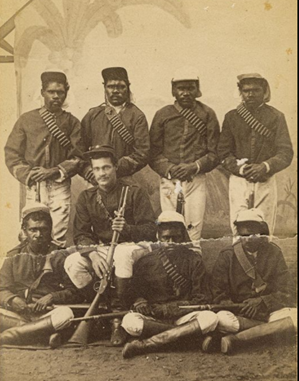
At first, Aboriginal people from southern regions who were unfamiliar with Queensland country and its tribal inhabitants were recruited and offered many benefits. Trained and equipped with uniforms and rifle, they were moulded into highly effective killing units. They became an ‘army’ of men who would ‘deal with Queensland’s Aboriginal problems’ for the next 55 years.
Native police were later recruited from within Queensland and most of them were highly effective trackers. They needed this skill so they could track fleeing Aborigines through bush and scrub. One of their officers is on record as saying, “These men could track a mosquito over a stone wall.”
Operating at various times from about 150 camps all over Queensland, they carried out dispersals, attacks and reprisal raids. Reprisals were usually extremely vicious and bloody. The aim was to punish those responsible for a crime, often the murder of a shepherd. Unfortunately, not only the perpetrators were targeted. Innocent men, women and children were killed without mercy in these bloody raids. In remote regions where the native police were the ‘unseen’ protectors of squatters and land holders, their dark deeds went unreported.
According to researcher, Timothy Bottoms, tens of thousands of Aboriginal people died at the hands of the Queensland Native Police and the same number again were killed by squatters and their sympathisers. His research suggests that at least 140 major confrontations took place throughout Queensland plus numerous smaller encounters which usually resulted in more killings. Of these tragic events, a few are mentioned below:
In 1843, a large group of squatters were ambushed by Aborigines at One Tree Hill (now called Tabletop Mountain), near Toowoomba. The squatters were forced to retreat but reprisal raids organised by squatters and soldiers brought a heavy toll on Aboriginal lives. Undaunted, the Aboriginal people organised powerful resistance and, although doomed to eventual failure, persisted for the next five years. This stands as an outstanding example of Aboriginal resolve to protect their people and their lands.
The Warroo Station near St. George in south west Queensland, was the scene of a massacre in 1848. Aborigines killed one or more stockmen working on the station. The corresponding reprisal raids are said to have killed over 100 Aborigines. There is an unconfirmed report of a mass grave on the station where 70 bodies are buried.
All but one of the Fraser family was murdered by Aborigines on Hornet Bank Station near Taroom in 1857. The European population were outraged and swift punitive action by the Queensland Mounted Police and settlers followed. An estimated 300 Aboriginal people were killed in reprisal raids.
In 1861, Aborigines killed 19 Europeans at Cullin-la-Ringo Station near Springsure. Incensed by the murders, a band of squatters stormed an Aboriginal camp and killed 30 of its occupants. The violence continued and it is possible that hundreds of Aborigines were killed as a consequence.
At Fort Rainworth near Springsure, a fortified building was built to repulse further attacks by Aborigines. It was never needed and stands today as a reminder of the violent past.
In the north of the state, Edmund Kennedy, speared by Aborigines while on a journey of exploration along Cape York in 1848, prompted violent and deadly reprisals by the Queensland Mounted Police supported by settlers and volunteers. Aboriginal men, women and children were killed in the process. Most of those killed had nothing whatsoever to do with Kennedy’s death.
The Jardine brothers and their team of drovers were taking a herd of cattle overland to Somerset near the tip of Cape York in 1864. This historic droving feat of 1,600 kilometres through scrubs, swamps and rivers was marred by clashes with Aborigines. Whenever attacked, the drovers responded with rifle fire resulting in multiple Aboriginal deaths. Their encounters included the “Battle of Mitchell River,” where records say 38 Aborigines died. The correct number of deaths is suspected as being significantly higher.
Discovery of the Palmer River goldfield in 1872 led to Aboriginal opposition and conflict with European and Chinese miners. Attacks by Aborigines almost invariably resulted in reprisals. Bullets from carbine and snider rifles accounted for 150 Aborigines during their attack at Battle Camp.
Now a good-news story. Newspaper headlines in 1875, hailed the saga of Frenchman, Narcisse Petellier. As a young lad he had been marooned on the east coast of Cape York where he was taken in and cared for by Aborigines for 17 years. He was coerced into reluctantly leaving his Aboriginal family and returned to his parent’s home in France. He spoke highly of his time amongst the Aborigines of Cape York and longed to go back to them. His experience shows how caring and nurturing Aborigines unaffected by European influences could be.
To the north-west of the state, close to what we know today as Mount Isa, relations between settlers and Aboriginal people continued to deteriorate as the land-grab spread ever further into the west. Hostilities between settlers and the Aboriginal population, especially the mighty warrior tribe, the Kalkadoons, showed no sign of abating. In 1878, a settler and his stockmen were slain and this led to even more extreme violence.
Kalkadoon warriors decided to attack Suleiman Creek homestead. Police inspector, Eglinton anticipated the attack and had sent for reinforcements. Facing fierce rifle fire, the brave Kalkadoon warriors armed with spears, had no chance of victory. An estimated 300 Kalkadoons died on that day.
Alexander Kennedy, a landholder in the area, travelled to Brisbane and asked for government help to quell the activities of Aborigines. The response was to send Sub-Inspector Frederic Urquhart to take charge of the unruly Native Police stationed near Boulia. He retrained these men and moulded them into a very capable fighting force then led them and a large contingent of volunteers into battle against the Kalkadoons. These mounted and armed men rode off to confront several hundred Kalkadoon warriors who had taken strategic positions on Battle Mountain near Kajabbi.

Urquhart ordered a cavalry charge, the only one ever to take place on Australian soil. Intended to take the Kalkadoons by surprise, the cavalry charge failed and for a while, the Kalkadoons held their positions. Urquhart then decided to attack on two fronts and this seemed to confuse the warriors. The Kalkadoons decided to confront their enemies head-on and rushed at them from their mountain hideaway. Rifles barked and warriors in their dozens fell dead. By the end of the battle, an estimated 100 Kalkadoon warriors lay dead. But this wasn’t the end of hostilities. Reprisal raids over the next few weeks killed every man, woman and child they encountered in a bloody conquest. Estimates of the dead range from between 300 and 900. Whatever the truth, authorities claimed the Kalkadoons had been tamed.
The last recorded Aboriginal massacre was at Mitchell River in 1884. This was the conflict already mentioned between Aboriginal people and the Jardine droving team. Although never officially recorded, confrontation and killings are known to have continued in remote areas well into the 20th century, even after the Queensland Native Mounted Police units were disbanded in 1904.
Oral histories suggest that land holders who lived far away from areas of public or police scrutiny, continued their vendettas against Aborigines. Several serious acts of armed aggression are alleged to have covertly taken place.
The incidence of killings declined during the 20th century. Control of the Aboriginal population continued by moving them into government or church-controlled missions. These institutions were designed to strip Aboriginal people of their lands, control their movement and alter their culture. They were also supposed to encourage assimilation into existing white societies.
TORRES STRAIT ISLANDERS AND LAND RIGHTS
To Queensland’s far north lie the islands of the Torres Strait. Colonial interest in this island group intensified when outsiders established a pearling industry there. Trepang and trochus shell industries followed. In 1879, an act of parliament gave the colony of Queensland authority over the islands.
This new sovereignty restricted the rights of islanders and interfered with their traditional culture. As with other colonial regimes, peoples of the Torres Strait were removed from their lands and repressive legislation further restricted their rights. Violent reprisals are known to have taken place against those who openly opposed colonial values. Despite this, the struggle for human rights and land rights continued. It took a long fight but finally, in 1992, a highly significant ruling was made.
Eddie Mabo grew up on Mer (Mulgrave) Island and later moved to Townsville where he and fellow activists continued their fight for land rights for indigenous peoples.
In June, 1992, The High Court of Australia handed down their Mabo decision recognising native title and overturning the terra nullius ruling which had existed since 1788.

After more than 100 years of dispossession and repression, the indigenous people of Australia and Torres Strait were finally recognised and granted land rights.
Mabo Day is commemorated annually on 3 June each year to honour the part Eddie played in securing indigenous land rights.
REFERENCES
BOOKS:
Conspiracy of Silence: Queensland Frontier Killing Times. By: Timothy Bottoms
Publisher: Allen and Unwin, 2013. ISBN: 9781743313824
Death Pudding: The Kilcoy Massacre. By James G. Lergessner
Publisher: Woorim, Queensland: James G Lergessner ISBN: 9780646477510
Taming the North: The Story of Alexander Kennedy and Other Queensland Pathfinders.
By: Wilmot Hudson Fysh.
Publisher: Angus and Robertson, Sydney, 1933.
The Reality of a Dark History. By: Val Donovan.
Publisher: Trails Network, Arts Queensland. ISBN: 0-7242-8092-8
NEWSPAPERS:
The North Australian, Ipswich. 8 Dec. 1857. “The Massacre at Hornet Bank station.”
Rockhampton Bulletin and Central Queensland Advisor. 2 Nov. 1861
Evening News, Sydney. 10 March, 1879. “The Perils of the Bush.”
IMAGES:
Kenneth McKenzie with mounted police, 1870, State Library of Queensland.
Kalkadoon memorial plaque, Battle Mountain, Kajabbi, Australian Frontier conflicts 1788-1940’s and beyond.
Eddie Mabo’s grave, Mer Island, 2015. State Library of Queensland
THE NEW ZEALAND WARS (also known as the Māori wars)
The New Zealand wars involved sporadic but deadly combat over 27 years between 1845 and 1872.
Māori chiefs who had signed the treaty of Waitangi in 1840, believed they were not ceding their lands and that they would not come under British sovereignty. The British took the opposite view and when an ever-increasing number of Europeans left the poverty of their homelands and began occupying Māori lands, fighting broke out all over the North Island. Although hopelessly outnumbered and outgunned by British military units, the Māori warriors offered stiff resistance using delaying tactics, ambush and guerrilla warfare.

British regiments stationed in Australia were sent to fight in the First Taranaki war of 1860-61. The government of Victoria sent their naval sloop, “HMCS (Her Majesty’s Colonial Service), Victoria”. The colony of Victoria was the first Australian colony to send a naval ship to a war zone.
When the New Zealand government sought more troops in 1863, recruitment began in Australia. Promised free land in return for three years of military service, approximately 2,500 men signed up. After years of fighting, most Māori opposition ceased in 1872, but few enlistees eligible for a land grant took up the offer.
According to available figures, 1,000 British soldiers died during the conflicts. Just over 2,000 Māori were killed with another 1,000-suffering severe gunshot and bayonet wounds. An unknown number of Māori non-combatants, men, women and children were killed in attacks on villages and from starvation and disease. 1,600,000 hectares of Māori land was confiscated.
Today, this dark period of New Zealand history is commemorated on Commonwealth Day and the government is committed to including this history in the school curriculum.
REFERENCES
Australian War Memorial: “New Zealand Wars, 1855-1872.”
Australian War Memorial: Image, “Storming the Rifle Pits at Te Ranga, 21 June, 1864.” Accession Number: ART50235.
State Library of Victoria: “New Zealand Wars 1845-1864.”
SOUTH AFRICAN WAR (SECOND BOER WAR) 1899-1902
Motivated mainly by greed, several European countries including Britain, recognised the economic and strategic advantages by annexing large areas of the African continent. With Britain’s push into South Africa, the Boer farmers, descendants of Dutch, German and French Huguenots who had farmed these lands since 1600, migrated north to avoid British domination. Here, they set up the republics of Transvaal and Orange Free State. Britain showed interest in these republics after vast quantities of gold was discovered in Transvaal. After negotiations between Britain and Transvaal’s President Kruger failed, war broke out.
Superior numbers of well-trained and well-armed British troops went into war with untrained and undisciplined Boer farmers. Despite extreme disadvantages, the Boers outperformed the British forces, particularly early in the war. The total Boer force of 60,600 men had only 35,000 men in the field at any one time. Compare this with the total number of British Empire troops of 448,000 men. By sheer weight of numbers and a vicious campaign by General Lord Kitchener which included disease ridden concentration camps in which over 28,000 Boer women children and men died, and the burning of crops and farm infrastructure, the British eventually won out and in May, 1902, Transvaal and Orange Free State was absorbed into the British empire.

All six Australian colonies sent troops to assist the British and after Federation in 1901, the Commonwealth Government committed battalions called Australian Commonwealth Horse. In total, 16,000 Australian troops served in South Africa with 606 fatalities. Australians won six Victoria Crosses.
REFERENCES
Australian War Memorial: “The Boer War 1899-1902.”
National Archives of Australia: “The Boer War: Australia and the War in South Africa, 1899-1902.”
National Army Museum, Chelsea, London: “Boer War.”
Image, Australian War Memorial: “Second South Australian Mounted Rifles Contingent, Boer War.” Circa 1900
SUDAN (NEW SOUTH WALES CONTINGENT) MARCH-JUNE 1885
In 1881, a Sudanese religious leader proclaimed himself as al-Mahdi, - the divinely guided one. He ignited a massive uprising against colonial rule and eventually established the Mahdist state. A rebellion by the forces of the Mahdi decimated the British-backed Turco-Egyptian rulers of Sudan. General Gordon, immensely popular throughout the British Empire, was sent to evacuate survivors. He managed to evacuate 2,000 children, women and wounded soldiers before he was killed by Mahdists during the siege of Khartoum in 1885.
In an act of patriotic fervour and the high regard for the slain General Gordon, the colony of New South Wales offered to send troops to assist the British in Sudan. Britain accepted and in March, 1885, amid much fanfare, the New South Wales Contingent consisting of a battalion of infantry and an artillery battery totalling 758 officers and men, embarked in Sydney. They disembarked at the Sudanese port of Suakin on the Red Sea.

Apart from a few minor skirmishes, they saw little military action. In a brief encounter with Mahdist forces, three Australian troops received gunshot wounds but suffered no other casualties. This action against the enemy is considered to be the first time Australian troops fought in an imperial war. (Australians had previously fought in the New Zealand wars but these troops had enlisted in the British military forces stationed in Australia.)
Britain decided to abandon the Sudan Campaign and the New South Wales Contingent returned home after just six weeks on African soil. During their overseas service, seven men died from illness and disease.
The New South Wales Contingent was welcomed home at Bennelong Point, (near where the Sydney opera house stands today), by an enthusiastic crowd.
REFERENCES
Australian War Memorial: “Sudan (New South Wales Contingent) March-June 1885”
RSL: “The War in Egypt 1885.”
NSW State Archives: “War and Australia-Sudan.”
Image AWM: Landing of Australian Contingent at Suakin-1885. AWM accession No. ART14435 (Public Domain).
THE BOXER REBELLION, CHINA 1900-1901
Members of a Chinese secret society became known as “Boxers,” because the martial arts they performed looked as though they were practising boxing. They believed their rituals protected them from their enemy’s bullets and this prompted thousands of them to join the rebellion. They aimed to expel foreigners, preserve Chinese culture and oppose treaties detrimental to China. They attacked and killed foreigners, missionaries and diplomats and destroyed foreign-owned property.
An eight-nation alliance of Britain, Japan, France, Russia, Germany, USA, Italy, and the Ottoman Empire, took military action. After heavy fighting, the Boxers were defeated and were then subjected to and controlled by the harsh, “Boxer Protocol” of 1901.
Three Australian colonies, NSW, Victoria and South Australia wanted to contribute to Britain’s effort in putting down the Boxer Rebellion. Already involved in the South African wars, they were short of troops, so NSW and Victoria sent naval brigades (sailors serving as infantry). Although the naval brigades saw little active service, they carried out other useful duties and helped restore civil order. When they left China in March, 1901, six men had died from illness or injury but none were killed by enemy action.
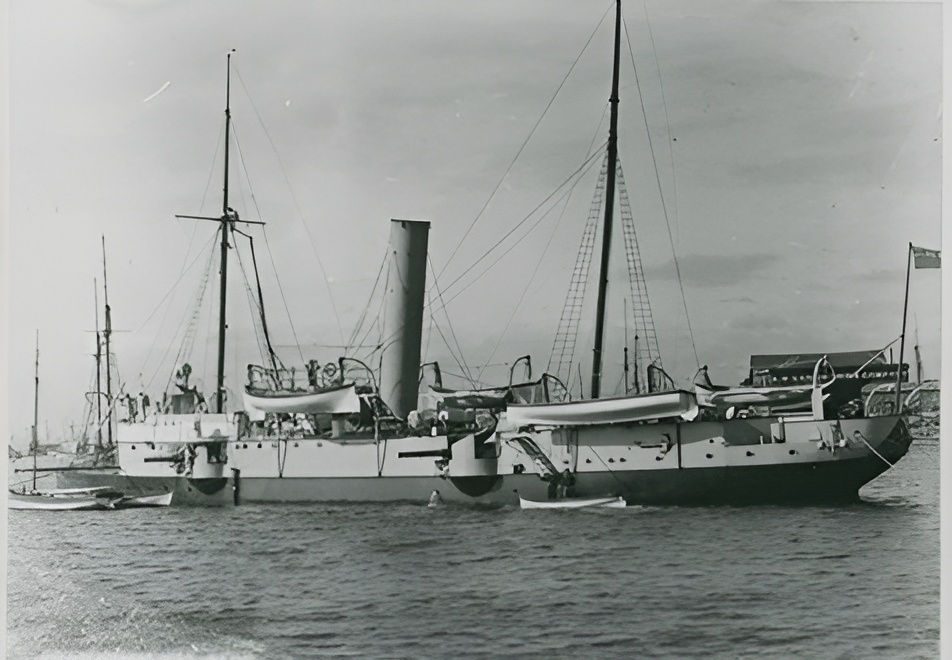
The South Australian government sent their gunship, “HMCS (Her Majesty’s Colonial Service), Protector.” Equipped with one 10-inch gun; five 6-inch guns; four Hotchkiss cannon and five 10-barrel Gatling guns, she arrived in Chinese waters when most of the heavy fighting was over and was employed mainly as a survey vessel. HMCS Protector returned to Australia amid much fanfare in November 1900 and was the first Australian warship used in foreign service.
Deployment of Australia’s naval forces paved the way for the establishment of the Royal Australian Navy.
REFERENCES
Australian War Memorial: “China (Boxer Rebellion), 1900-1901.”
South Australian History Hub: “HMCS Protector.”
Roya Australian Navy: “The Boxer Rebellion and HMCS Protector.”
Image, State Library of South Australia: HMCS Protector, 1901. B18116
WORLD WAR ONE 1914 - 1919
The assassination of Archduke Franz Ferdinand of Austria in June 1914, created a chain-reaction. Complex political and military factors prompted Germany to declare war on France and invade Belgium. Britain had now to make a choice: intervene or accept the probability of German domination of Western Europe. Under the 1839 Treaty of London, Britain guaranteed Belgian neutrality and it saw the German invasion as its obligation to defend Belgium. Britain declared war on Germany in August 1914. Its first major land battle occurred at Mons in the southwestern part of Belgium. The British Expeditionary Force was forced into retreat by the German 1st Army. British Empire forces retreated 400 kilometres toward Paris. Over the next four years and three months, fierce trench warfare, aerial bombardment, tank attacks and Naval battles would take hundreds of thousands of lives. This was the first time tanks and aircraft were used in war, and, with devastating effect.
As part of the British Empire, Australia was also thrust into the war and became involved through the Australian Imperial Force which fought in New Guinea, Gallipoli, France, Belgium and the Middle East.

The Royal Australian Navy served with the British Grand Fleet in the blockade of Germany. This, one of the most decisive operations of the whole conflict, cut Germany off from overseas trade. Germany’s navy was unable to break the blockade and its merchant fleet was trapped in port. HMAS Sydney had previously destroyed the German light cruiser, SMS Emden in 1914, near the Cocos (Keeling) Islands.
The fledgling Australian Flying Corps (AFC), served in the Middle East and along the Western front in France and Belgium. These aircraft were used for both surveillance and in attack. Several Australians who served in the AFC went on to achieve great success in peacetime. Among these men was Hudson Fysh, co-founder of Qantas in 1920.
2,300 nurses enlisted for overseas service in the Australian Army Nursing Service (AANS). Twenty-five nurses died while in service. At Gallipoli, they served in hospital ships and at Lemnos Island, just 60 kilometres from Gallipoli. In Belgium and France, they worked at casualty clearing stations and were often subjected to shellfire, air raids and gas attacks. Others worked in desert hospitals and at the clearing hospitals in Egypt.
The Australian Naval and Military Expeditionary Force (AN&MEF), seized the German Pacific colonies in New Guinea, New Ireland, New Britain, Admiralty Islands and Bougainville at the beginning of hostilities. This action neutralised Germany’s ability to use these locations to launch attacks on Australian ports and shipping lanes and reduced the possibility of enemy radio broadcasts.
Members of the Royal Australian Navy Bridging Train, (RANBT), were trained to carry out all the engineering works necessary to expedite amphibious landings while working under enemy fire. They constructed the pontoons, piers and landing stages for the amphibious landings at Gallipoli.
The famous Australian Light Horse served firstly at Gallipoli, without their horses. After Gallipoli they served in Egypt, Syria and Palestine where they mounted the iconic mounted charge at Beersheba. Their cavalry battle at Megiddo, is seen as one of their most decisive victories.
After the ANZAC landings at Gallipoli, Australians distinguished themselves in many of the great battles in France and Belgium including on the Somme, Pozieres, Bullecourt, Messines, Ypres. The combined Australian and American victory at the battle of Hamel set the standard for later advances. The Australian night attack on Villers Bretonneux, which halted the German advance, is hailed as, the war’s greatest feat. To this day, Villers Bretonneux is proud to display the signage, “Never forget Australia.”
After years of gruelling and bloody warfare under the worst imaginable conditions, the armistice was signed on 11th November 1918.
In total, between 9 and 11 million combatants were killed. Between 6 and 13 million civilians were killed or died as result of this war.
From Australia’s population in 1914 of five million, 416,809 enlisted for wartime service with 313,814 serving overseas. 60,000 were killed; 155,000 wounded and 4084 taken prisoner. 397 died in captivity. Of those who returned home, thousands died premature deaths. Many who suffered what was then known as, ‘shell shock,’ (known today as Post-Traumatic Stress Disorder or PTSD), were placed in asylums. Many affected ex-combatants took their own lives.
The ‘war to end all wars,’ took a terrible toll on Australia’s youth as row upon row of grave stones in foreign cemeteries and at home in Australia attest.
REFERENCES
Australian War Memorial: “Battles First World War.”
Australian War Memorial: “1st. Australian Light Horse Regiment.”
Sir John Monash Centre Australian National Memorial, France: “The Battle of Villers Bretonneux.”
National Archives of Australia: “First World War. 1914-18”
Image, State library of New South Wales: Frank Hurley photograph, “Over the top,” Zonnebeke, 1917. Public Domain.
WORLD WAR TWO 1939 - 1945
Harsh penalties imposed on Germany after WW1, caused resentment and economic hardship. This led to the rise of the extremist politics of Adolf Hitler and the Nazi Party. Mussolini’s fascist regime gained prominence in Italy and Imperial Japan began expansion into East Asia and the Pacific region. These three countries became axis powers in WW2.
When Germany invaded Poland in September 1939, Britain and France declared war on Germany. Australia, also at war, sent soldiers, airmen and naval forces to support Britain in Europe, North Africa and the Mediterranean. The first hostile act of war took place on 3 September 1939 when the German submarine, U 30, torpedoed the British passenger liner, SS Athena. The Battle of the Atlantic had begun and would continue for the duration of the war. 13.5 million tons of allied shipping was destroyed and tens of thousands of lives lost.
Germany, using their fast-moving tactics of blitzkrieg, invaded France in May 1940. Allied forces which included Britain, France, Belgium and Netherlands, were forced into rapid retreat. France surrendered and signed an armistice with Germany. 338,000 British and allied troops trapped at Dunkirk were evacuated to Britain in a remarkable rescue mission by Royal Navy ships and 700 private boats. German forces entered Paris in June 1940.
In mid-1940, aircraft of the German Luftwaffe attacked Britain. Using mainly Spitfires and Hawker Hurricanes, Britain won a decisive air victory and this forced Germany to defer their planned invasion. This, the Battle of Britain, proved that the might of Germany could be overcome.
Allied forces, including Australia, engaged Italian, German and Vichy French forces in North Africa. Their main aim was to prevent the Suez Canal from falling under axis control. Besieged by Italians and General Rommel’s Afrika Corps, the “Rats of Tobruk,” held the port of Tobruk for eight months. Later, at the second battle of El Alamein, Australian troops helped force the Africa Corps into retreat.
In June 1941, Operation Barbarossa, the biggest military operation in history, saw Germany invade the Soviet Union. The series of battles and sieges which ensued claimed an estimated 1 million German casualties and 5 million Russian casualties. Germany was forced to withdraw.
In December 1941, the U.S.A. entered the war after the Japanese bombed its naval base at Pearl Harbour in Hawaii. The U.S. army, navy and air force now fought in both the European theatre of the war and the Pacific theatre where they added much needed personnel, weaponry and equipment. They saw action in North Africa, Italy, Sicily, France, Belgium and the Netherlands as well as within the vast Pacific region. The presence of U.S. men and machines at the Normandy ‘D’ day landings on 6 June 1944, was vital to the success of this very dangerous amphibious undertaking. Along with their allies, they liberated Paris the following August and then began their long thrust toward Germany. US troops encountered exceptionally strong German opposition at the Battle of the Bulge in the Ardennes region of Belgium and Luxembourg. 19,276 Americans were killed, more than any other battle in the war.
When the Americans arrived in Berlin, they learned that Hitler and some of his followers had committed suicide. Americans and their allies began restoring essential services and establishing law and order in preparation for rebuilding the devastated city.
The unconditional surrender of the Third Reich was signed on May 7, 1945, at U.S. General Dwight D. Eisenhower’s headquarters in Reims, France.
When Japanese forces invaded Malaya and Singapore in 1941-42, an invasion of Australia seemed imminent. the Australian Prime Minister, John Curtin, called on Australian troops serving in North Africa to come home and defend their native land. He also asked the U.S.A. for help and in December 1941, General MacArthur, along with thousands of American troops, poured into Brisbane and other Queensland coastal cities and towns.
Japanese bombers hit Darwin and other northern centres in early 1943. Coastal Queensland prepared defences for expected further attacks. Australian troops were despatched to New Guinea to halt the Japanese advance and they fought in the notable battles of the Kokoda Track, Milne Bay, Buna Gona and many others. Within sight of Port Moresby, the Japanese overland advance was halted by the Australians.
The AIF, RAN, RAAF, were all involved in hostilities in New Guinea, Bougainville, Borneo and the Coral Sea (1942), and Guadalcanal (1942-43).
After Pearl Harbour, American forces achieved mixed success until they turned the tide of war at the battles of Coral Sea in May 1942; Midway in June 1942; Guadalcanal in February 1943; Philippine Sea in June 1944 and the largest Naval battle in history, the Battle of Leyte Gulf in October 1944. The Japanese Imperial Navy lost a total of 28 ships including four aircraft carriers in this battle and they ceased to be an effective fighting force. The Japanese now mounted deadly Kamikaze attacks on U.S. vessels.

(Aircraft Carrier USS Lexington was later sunk by Japanese aircraft at the Battle of Coral Sea.)
Despite the Japanese army, navy and air forces all being reduced to ruin through years of combat, they refused to surrender. This prompted the President of the U.S.A. to authorise the use of the newly developed Atom bomb on Hiroshima. This devastated the city and instantly killed an estimated 70,000 residents. When no surrender was forthcoming, a second atomic bomb devastated Nagasaki in August 1945. Japan finally surrendered on 15 August, 1945, and this is proclaimed as, “Victory in the Pacific Day.”
Representatives of Europe and Japan signed the instrument of surrender aboard the U.S.S. Missouri in Tokyo Bay on 2 September 1945. General Douglas MacArthur signed on behalf of the Allied Powers. Delegates from U.S., U.K., U.S.S.R., China, Australia, Canada, France, and the Netherlands also signed.
39,658 Australians died or were killed during WW2. Of the 5,000 Australian nurses who served overseas, 78 died including the 22 massacred by the Japanese on Banka Island. Of the 22,000 Australian prisoners taken by the Japanese, 8,000 died in captivity.
With the end to hostilities, the task of locating, bringing home and restoring the health of surviving prisoners of war began. Australia now began the long process of rebuilding the nation.
REFERENCES
Australian War Memorial, Canberra: “Kokoda Trail Campaign.”
“Normandy Landings, World War Two.”
Royal Australian Navy: “Battle of the Coral Sea.”
National Army Museum, U.K.: “The Struggle for North Africa, 1940-43.”
Australian War Memorial, London: “Borneo, the end in the Pacific, 1945.”
Image, Cradle of Aviation Museum, New York: Hellcat aircraft landing aboard USS Lexington, 1940.
POST-WAR OCCUPATION OF JAPAN 1945 to 1952
Australia contributed 12,000 troops to the British Commonwealth Occupation Force (BCOF), and were responsible for enforcing the terms of Japan’s unconditional surrender which was signed on 2nd September 1945. United Kingdom, Australia, India and New Zealand were all involved but United States provided by far the most military and non-military personnel.
Australia also provided 153 Royal Australian Army Nursing Service (RAANS), nurses plus nurses from the RAAF Nursing Service (RAAFNS). These nurses cared for Australian and other personnel and assisted with air transport of casualties.
General MacArthur oversaw the duties of the occupying forces and these included the disarming of Japan and the institution of a new constitution empowering democratic government and reducing the authority of the emperor. The main aims were to eliminate Japan’s ability to wage war; transform the country into a stable democracy and rebuild its economy. The Allies believed that an economically stable Japan would prevent further conflict in the Pacific region.
After their defeat and the devastation of war, the Japanese, as a nation, were determined to rebuild their country’s economy. With assistance and cooperation with the U.S., plus dedication and hard work, Japan made a remarkable economic recovery which benefited all her many citizens. What became known as the “Japan Economic Miracle,” resulted in the once war-ravaged country becoming world leaders in shipbuilding, automobile production, electronics and precision engineering. Their GDP grew at hitherto unseen record levels. Their recovery from horrendous wartime damage to economic power-house, was swift and permanent.
The U.S. and Commonwealth occupying forces withdrew in April 1953, leaving Japan a democratic and highly productive country. Only the U.S. military bases remained under the separate U.S.-Japan Security Treaty.
REFERENCES
Australian War Memorial: “Australia’s Involvement in Occupation of Japan.”
Australian War Memorial: “Cold War Nurses.”
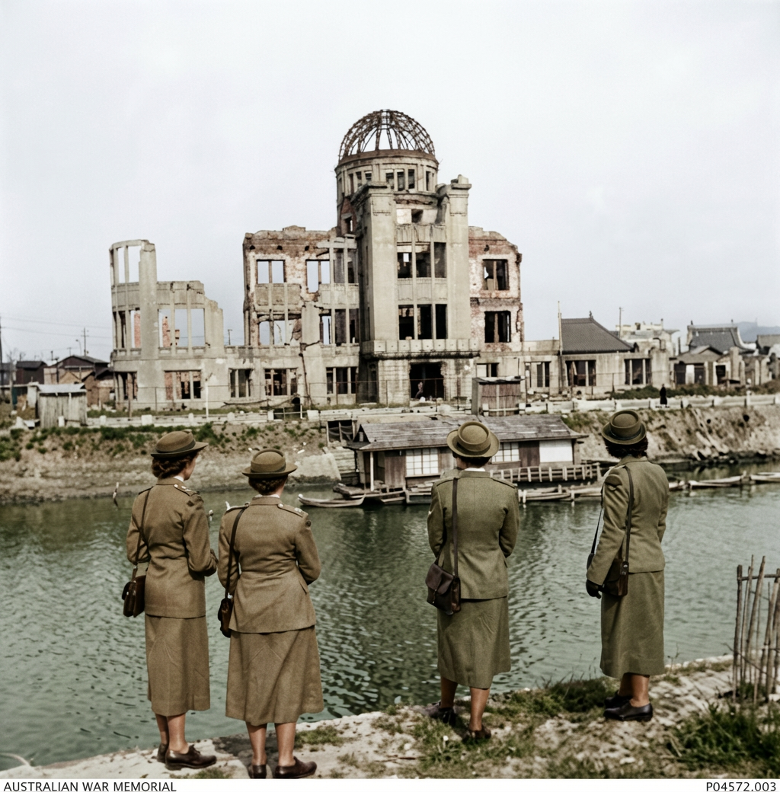
Australian War Memorial Image: “Australian Army Nurses, RAANS, from British Commonwealth General Hospital, visit the ruins of Hiroshima, 1955.” Accession No: P04572.003
THE MALAYAN EMERGENCY 1948 to 1960
After WW2 and the end to the Japanese occupation of Malaya, the Malayan Communist Party and its armed wing, Malayan National Liberation Army (MNLA), sought to establish an independent communist republic. They began their quest by attacking police stations, mines, plantations and infrastructure. In 1948, three British plantation managers were assassinated and the government declared a state of emergency. The British sent troops in June 1948, and the Malayan Emergency confrontation began. It continued for 12 years until 1960.
The communist uprising was one reason for Britain to send in troops. The British also valued Malaya’s rubber and tin resources, the proceeds from which they used to repay their war debts to U.S.
The Malayan National Liberation Army used guerrilla tactics and engaged in ambushes and raids against British forces. Retaliation became difficult because insurgents mixed with the local villagers which made them difficult to identify. In 1948, British soldiers sent to apprehend insurgents, massacred 24 unarmed villagers, causing huge controversy and stirring hatred.
The British Commonwealth forces used a range of military strategies including the Briggs plan where thousands of Chinese suspected of supplying food to the enemy were rounded up and domiciled in secure compounds. Crops grown to feed the insurgents were sprayed with defoliants (similar to agent orange used later in the Vietnam war).
While the enemy in the jungle relied on stealth and knowledge of the terrain, specially trained dogs proved invaluable in tracking them down. Dogs also helped find Allied soldiers wounded or lost in the jungles.
Later, the British tried the ‘hearts and minds,’ strategy which provided incentives for the communist supporters to give-up their opposition.
Australia sent infantry and artillery units, plus engineers and nurses. The RAN supplied 13 ships between 1955 and 1960. In addition to transport and surveillance, some ships engaged in active service by bombarding enemy positions.
The RAAF supplied transport and bomber aircraft and Sabre jet fighters from Butterworth air base in Malaya.
After years of conflict, independence was declared in 1957, which saw the end to British Colonial Rule and the formation of the Independent Federation of Malaya. The insurgent fighters now had less reason to continue in combat and fighting died down. In July 1960, the Malayan government declared the state of emergency over,
and the British and Allied forces withdrew.
Australian forces had served for 13 years from 1950 to 1963, making this their longest military commitment in their military history. Australia ‘stayed the distance’ because Malaya was strategically vital during the ‘cold war.’ Of the 7,000 Australians who served, 39 were killed and 27 wounded.

REFERENCES
Australian War memorial: “The Malayan Emergency, 1948 to 1960.”
Department of Veterans Affairs: “Army operations during the Malayan Emergency.” Anzac Portal.
Prof. Karl Hack, The Open University, U.K.: “The Emergency 1948-1960: Malayan communist party strategies.”
Image, Royal Australian Air Force Heritage Collection: : CAC Sabre jetfighters were flown by RAAF No.3 and No. 77 Squadrons from Butterworth Air base, Malaya, during the Malayan Emergency.
KOREAN WAR 1950-1953
Sometimes referred to as, “The forgotten war,” the 17,000 Australians who fought in the Korean war under the United Nations flag, found it to be an unforgettable and brutal war against a fanatical enemy.
After the end of WW2, the Allies were entrusted with control of the Korean peninsula which had previously endured 35 years of Japanese occupation. The Soviet Union took control of the country north of the 38th parallel and fostered a communist government. The U.S. supported the democratic style of government south of the 38th parallel. Opposing ideologies saw tensions rise until the Korean Peoples Army launched a massive offensive into the south. The U.S. intervened under the United Nations flag and supported the retreating armies of the south. The conflict was seen as a struggle between communism and democracy and was the first military action of the ‘cold war’ which mirrored the divide between communism and liberal democracy.
China entered the war in October 1950 and launched major attacks against the southern armies.
Australian Prime Minister, Menzies, committed all three forces to fight in this war.

The Royal Australian Navy contributed HMAS Sydney, Bataan, Anzac and Warramunga. These vessels carried out carrier strikes, bombardments and blockades.
The Royal Australian Air Force No. 77 Squadron flew 19,000 sorties during their time in Korea but heir Mustang and Meteor aircraft were no match for the advanced Soviet built, MiG-15 jet fighters. 37 pilots were killed and 6 taken prisoner.
The 3rd Battalion Royal Australian Regiment fought in 12 major battles. Often outnumbered and outgunned, they fought in the notable battles of Kapyong and Maryang San which halted major Chinese offences. Trench warfare, hand-to-hand combat and a determined and fanatical enemy made combat very tough and unpleasant.
An armistice signed in July 1953 set out an agreement between United Nations Command, North Korea and China and delineated a front line at the 38th parallel, exactly where it was originally. Without a peace treaty, the situation between north and south Korea remains tense.
Australia’s losses were 339 killed and 31 taken prisoners.
REFERENCES
Australian War Memorial: “Korean War, 1950-1953.”
Australian War Memorial: “Mustangs, Meteors and Mig’s. No. 77 Squadron.”
RSL, Queensland: “Remembering Australia’s Part in the Korean War.”
Image, Imperial War Museum, Cat.No. KOR648: “Infantrymen of 3rd Battalion Royal Australian Regiment ride on Centurion tank taking them to their positions north of Imjin River, Korea 1951.”
VIETNAM WAR 1962 – 1975
The catalysts for the start of the Vietnam war are complex and stretch back to the French colonial rule (1859 – 1954), and joint occupation with Japan (1940 – 1945). With political support by Ho Chi Minh, the forces of North Vietnam defeated the occupying French in 1954. The Geneva Accord then divided Vietnam into the north, backed by a communist regime, and the south, backed by western powers. In November 1955, United States assumed responsibility for supporting the South Vietnamese government. Combat between north and south Vietnam forces escalated when U.S. landed combat troops at Da Nang in 1965. U.S. troop commitments increased from 23,300 in 1965, to 536,000 in 1968.
In a war dominated by guerilla tactics, the U.S. had to contend with numerous small-scale encounters but also fought in several major confrontations. Of the five major battles contested, the Tet Offensive and the Battle of Hamburger Hill are probably the best known. In all situations, helicopters were essential to move troops in and out of battle zones and to evacuate injured soldiers.
U.S. and Australian involvement in this war, always controversial, became even more so when U.S. used a total of 12 million gallons of Agent Orange and 8 million gallons of other chemical defoliants plus 388,000 tons on napalm to thin out jungle growth where enemy soldiers could hide, and to destroy crops and livestock. American and Australian servicemen and Vietnamese civilians would later suffer cancer and other severe health issues caused by exposure to these chemicals.

Both sides used guided missile technology. The U.S. developed and used Laser Guided Bombs (LGB’s), which hit their targets with exceptional accuracy.
During the course of the war, the U.S. dropped a staggering 7,078, 032 tons of bombs, over three times the amount dropped during the whole of WW2.
North Vietnamese guerilla tactics worked effectively against their much stronger and better equipped opponents. They employed hit-and-run tactics, booby traps and night attacks. They used an extensive tunnel system, some over 400 kilometres long, which housed kitchens, hospitals, supply depots and command centres. Secret tunnels allowed soldiers to emerge unexpectedly to carry out surprise raids.
Co-ordinated attacks on over 100 South Vietnamese cities and towns in January 1968, known as the Tek Offensive, took U.S. and its allies by surprise. The offensive resulted in a defeat for the North Vietnam forces but it eroded public support for the war in U.S. The operation convinced the army chief that a U.S. victory would require 700,000 troops for up to five years. Based on this and other findings, the U.S. government decided to de-escalate military operations and troop numbers were gradually reduced.
The Paris Accord of 1973 ended active U.S. combat activities. The north and the south continued to wage war until North Vietnamese forces captured the South Vietnamese capital of Saigon in April 1975.
Australian involvement began in 1962 when the government, wishing to strengthen the ANZUS alliance and contain the spread of communism, sent troops to fight in the Vietnam war. The arrival of the Australian Army Training Team Vietnam (AATTV), marked the beginning of Australia’s involvement. Other army units followed. The RAAF sent Caribou transport aircraft, Iroquois helicopters and Canberra jet bombers. The RAN deployed destroyers, patrol vessels, helicopter detachments and diving teams. Army, air force and civilian nurses arrived to care for injured and sick personnel.
In 1964, the Australian government introduced the National Service Scheme which allowed 20-year-old conscripts to be called-up for service in Vietnam. Of the 60,000 men conscripted, 18,000 served on active service in Vietnam. Over 200 were killed and 1,200 wounded.
Australians fought in several major battles including the battle of Long Tan where 108 soldiers of D Company, 6th. Battalion, Royal Australian Regiment, assisted by RAAF helicopters, kept an enemy force of 2,000 at bay for four hours.
When body bags began arriving back in Australia along with the many wounded conscripts, opposition to the war was expressed in Anti-Vietnam War marches, moratoriums and mass protests. The government decided to bring Australian troops home in stages and finally declared the end to combat duties in December 1972.
Unlike other wars, returning servicemen and women from the unpopular Vietnam war, did not always receive positive welcomes. Since that time, Australians have recognised their outstanding service and bravery under the most difficult and changeable circumstances of war.
REFERENCES
Image: Wikimedia Commons: “Napalm strike erupts near U.S. troops on patrol, South Vietnam, 1966.”
Department of State, United States of America: “U.S. Involvement in the Vietnam War: the Tet Offensive.”
Australian War Memorial: “Vietnam war 1962 – 1975.”
Department of Veteran’s affairs: “Agent Orange and other chemicals in the Vietnam war.”
Anzac Portal: “Withdrawal of Australian troops from Vietnam War.”
INDONESIAN CONFRONTATION 1963 – 1966
Creation of the Federation of Malaysia in 1963 which included Malaya, Singapore, North Borneo, Sabah and Sarawak (Singapore later withdrew), was seen by Indonesia’s President Sukarno as a continuation of British colonial influence in the area. President Sukarno announced a “Crush Malaysia,” campaign and a number of so-called Indonesian ‘volunteers’ attempted to seize Brunei, the only sovereign state on the island of Borneo. British and Gurkha troops thwarted their attempts. Indonesians then began sabotage raids into Malaysian territories of Sarawak and Sabah and by 1964, the Indonesian army had become involved.
Indonesia had indirect support from USSR and China, making the confrontation an episode of the cold-war in Asia. The U.K., Australia and New Zealand supported Malaysia.
Despite requests from the British and Malaysian governments, Australia delayed involvement until 1965 when the 3rd Royal Australian Regiment arrived in western Sarawak. They were followed by infantry and artillery battalions, engineers, signals and Special Air Services, all supported by RAAF squadrons and ships of the Royal Australian Navy.

The confrontation ended in 1966 after Sukarno lost power to General Suharto and Indonesia then recognised Malaysia.
A peace treaty was signed in Bangkok in August, 1966.
23 Australians were killed during the confrontation and 8 were wounded.
Sensitivity about cross-border issues meant that the confrontation received little press coverage in Australia.
REFERENCES
Image: Australian War memorial: “102 Field Battery, Borneo, 1965, engaging target with 105mm Howitzer. AWM CUN 659778MC.
Singapore Infopedia: “Federation of Malaysia.”
Australian War Memorial: “Indonesian Confrontation 1963-66.”
National Museum of Australia: “Indonesian Confrontation.”
THE GULF WAR 1990-1991
The military forces of Iraqi dictator, Saddam Hussein, invaded the neighbouring country of Kuwait on 2 August 1990. The United Nations Security Council condemned the invasion and demanded an Iraqi withdrawal. Sanctions were put in place. When Saddam Hussein ignored these demands, a massive force of U.S. led coalition troops from 35 nations combined to enforce the United Nations sanctions.
Operation Desert Shield began a defence build-up of coalition forces designed to prevent Iraqi forces from pushing into Saudi Arabia and to prepare for the liberation of Kuwait. A full-scale war, Operation Desert Storm, then began 42 days of air strikes on Iraqi military targets in Kuwait and bombing of the Iraqi capital, Baghdad. Coalition ground forces went into action and expelled the Iraqi forces from Kuwait but as the Iraqis withdrew, they set over 600 Kuwaiti oil wells on fire.
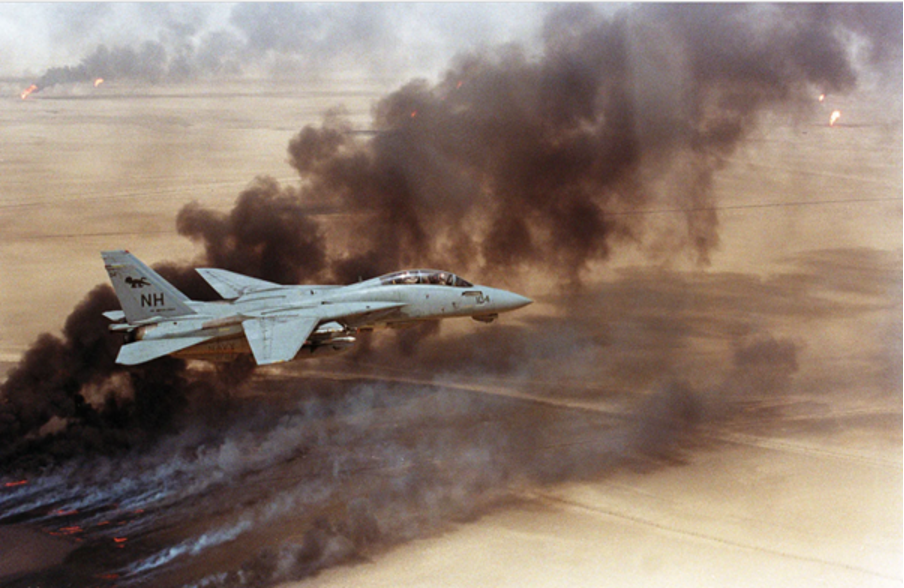
Iraqi forces suffered extremely high casualties, and with their military air and ground facilities destroyed, they were incapable of continuing the war. A ceasefire was declared on 2 February, 1991.
The aim of the confrontation was to liberate Kuwait, not the downfall of Saddam Hussein. So, despite his military defeat and being subjected to strict international sanctions, Saddam Hussein remained in power. He employed extreme violence against those who opposed him and his brutal regime continued until 2006 when he was captured and executed.
Australia provided 1,800 Defence Force personnel including ships of the Royal Australian Navy. Guided missile frigates HMAS Adelaide and HMAS Darwin enforced sanctions against Iraq. These were replaced on rotation by guided missile destroyer HMAS Brisbane and frigate, HMAS Sydney, both of which formed part of the screen around the U.S. aircraft carrier group. The RAN Clearance Diving Team performed explosive disposals in Kuwait.
Australian Defence Force medical teams served aboard the U.S. hospital ship, USNS Comfort. Australian Army personnel acted in several roles other than combat. They supplied engineers, logistics and support personnel including intelligence and medical staff.
No Australian lives were lost during the conflict.
After the war, some A.D.F. personnel remained to provide humanitarian aid, particularly for displaced Kurdish refugees.
RAN ships remained until November 2001 to help enforce the sanctions against Iraq.
REFERENCES
Image: U.S. Department of Defence, photo, Lt. S. Gozzo: “U.S. F-14 flying over Kuwaiti oil wells set alight by Iraqi troops, the Gulf War 1990-91.”
U.S. Department of War: “Desert Storm: A Look Back,” Feb. 16, 2026.
Australian War Memorial: “The Gulf War: Australia’s contribution 1990-91.”
Department of Veterans Affairs (2006): “Australians in the Gulf War 1990 to 1991, DVA, Anzac Portal.”
IRAQ WAR 2003–2009
In 2003, U.S. President George W. Bush, convinced that Iraq possessed weapons of mass destruction, authorised a U.S.-led coalition to invade the country. Intelligence reports suggested the presence of biological, chemical, and possibly nuclear weapons. Another key objective was the removal of Saddam Hussein, whom the U.S. viewed as a threat to both Iraq’s population and regional stability.
Although the ANZUS treaty does not obligate member nations to provide automatic military support, Australian Prime Minister John Howard committed troops under its terms. Australian army, navy, and air force units participated in coalition operations.
Combat operations began in March 2003. The United States deployed 235,000 troops for the invasion, with an additional 340,000 in other supporting operations. The United Kingdom contributed 50,000 troops, Australia 2,000, and Poland 200. Coalition forces utilised advanced weaponry, including satellite-guided bombs, cruise missiles, guided rockets, and stealth aircraft.
Iraqi forces were swiftly overwhelmed. The U.S. conducted two “Thunder Runs” with Abrams tanks and armoured vehicles to penetrate and secure Baghdad. These rapid assaults quickly subdued Iraqi resistance, leading to the fall of Baghdad and the end of Saddam Hussein’s regime. Major combat operations concluded by May 2003, but a prolonged insurgency followed, challenging coalition control. The war officially ended in December 2011. Notably, no weapons of mass destruction were ever found.

Australian Involvement
Australian Special Forces performed reconnaissance and designated targets for coalition strikes.
Australian Army personnel provided training, security, and reconstruction assistance to help reestablish stability in post-war Iraq.
The Royal Australian Air Force (RAAF) deployed F/A-18 Hornets for strike missions, while other aircraft supported surveillance and refuelling operations.
The Royal Australian Navy (RAN) contributed escorts, mine clearance, and amphibious support, with frigates HMAS Anzac and HMAS Darwin conducting escort and interception duties.
Although Australian combat operations ceased before the war’s official end, a contingent remained to assist with reconstruction and rehabilitation until all personnel were withdrawn by 2011. In total, 17,000 Australians received the Iraq Medal for their service. Five Australians died during the conflict.
The United States suffered 4,500 fatalities and 32,000 wounded. Estimates of Iraqi deaths vary, but reliable sources place the number at over 460,000.
REFERENCES
The Washington Post, March 2023: “The Army’s ‘Thunder Run’ to Baghdad to oust Saddam Hussein.” (2003). (IMAGE)
American Grit: “The Gamble for Baghdad—An Account of the 2003 Thunder Runs.”
Australian War Memorial: “Australians in Iraq 2003–2013.”
Australian Government Department of Veterans’ Affairs, Anzac Portal: “Australia’s involvement in Gulf War II – 2003–2005.”
AFGHANISTAN WAR 2001 to 2021
In 2001, Australia invoked the ANZUS Treaty in order to support the U.S. in its “War on Terror,” following the al-Qaeda airborne attacks on the World Trade Centre in New York.
Over 40,000 Australian Defence Force personnel were deployed on a rotational basis from 2001 until 2021. Australia’s mission was to combat the forces of the Taliban and al-Qaeda, which were seen as terrorist organisations, and also to stabilise and reconstruct Afghanistan. Australians served in the International Coalition against Terrorism, involving the Royal Australian Navy, Australian Army and Royal Australian Air Force.
In addition to Special Air Service and Commando units, several Royal Australian Regiments formed the battle groups, including Infantry, Cavalry, Engineers and Signals. These men and women were also required to train and mentor the Afghan National Army Units who were supposed to take military control of Afghanistan when U.S. and allied troops eventually withdrew.
The Royal Australian Navy played a vital supporting role by conducting regional operations in the Persian Gulf and the Indian Ocean. They enforced sanctions, protected allied shipping and intercepted vessels suspected of carrying weapons for Taliban or al-Qaeda networks. Ships served on a rotational basis. Two sailors were wounded, but none were killed.
The Royal Australian Air Force provided airlifts of personnel and equipment, medical evacuations, intelligence and air traffic control. Several Australians flying in U.S. helicopters lost their lives, but no RAAF aircraft or other personnel were lost during the conflict
Australian women enlisted in all three services where they served in medical, engineering, intelligence and air operations. Several received Distinguished Service Decorations for courageous and exceptional service in combat-exposed roles.

The first Australian combat operations occurred in Kandahar Province, where the Special Air Service Regiment was deployed alongside U.S. forces. Special Forces Task Group aided in the capture of the strategically important Kandahar airport.
In Uruzgan province, Australian infantry, aviation units and special forces carried out raids and counterinsurgency operations against the Taliban. They faced ambushes, improvised explosive devices and direct military contact or firefights, especially during village clearances in Tarin Kwot, Chora Valley and Baluchi Valley. The Special Operations Task Force mounted night raids on Taliban commanders, plus capture-and-kill missions and helicopter insertions. These were amongst the most dangerous interventions. Twenty Australians died in confrontations in Uruzgan province.
After serving in Uruzgan province, combat missions formally ended, and efforts shifted to mentoring and training Afghan personnel. Logistics and airlift operations continued. The ultimate aim was to prevent Afghanistan from becoming a safe haven for terrorists and to build Afghan security forces capable of governing and defending the country.
After a long offensive, Kabul fell to the Taliban in August 2021. This ended the 20-year U.S. led war. The existing government collapsed, and the Afghan Defence and Security Forces, who were supposed to take control, abandoned their posts, and many, fearing reprisals, fled. The Taliban took control and declared the Islamic Emirate of Afghanistan reinstated. The economy of the country rapidly declined under the Taliban leadership, and this caused a severe humanitarian crisis, including widespread starvation. Under the Taliban regime, women’s rights were severely curtailed.
After the Taliban takeover, the RAAF, in one of its biggest ever humanitarian airlifts, evacuated 4,100 people on 32 flights out of Kabul. Every landing and take-off became a high-risk operation with evacuees and aircraft under constant threat. This air operation is considered one of the most significant of the 21st century, and the squadrons involved received well-earned commendations.
A total of 47 Australians were killed during the Afghanistan conflict, most in combat and others in helicopter and vehicle crashes, land mine explosions and training incidents.
Australia has faced two important problems since the conclusion of the Afghanistan war. The first concerns possible war crimes. The Brereton Report of 2020 aimed to reveal any misconduct by Australian Special Forces on deployment to Afghanistan between 2005 and 2016, and to suggest changes to guard against similar occurrences in the future.
The second problem concerned the entire Australian military personnel, particularly veterans:
Over 1,800 suicides of ADF members and veterans occurred between 1997 and 2023, and this includes a disproportionate number of Afghanistan war veterans. Subsequent Royal Commission recommendations have improved available services for veterans. Mental health, family counselling, education, housing assistance and other services are now available for veterans, and access to these resources has been streamlined.
REFERENCE SOURCES:
Image: Australian Government Department of Defence; Creative Commons, March 2010: Corporal Amanda Wright, Corporal Cindy Veenman and Captain Karin Cann outside the wire of Multinational Base, Tarin Kwot.
Washington Center for Human Rights: “The long Road to Justice for Afghan War Crimes.” October 2025.
Anzac Portal: “Australians in the war in Afghanistan 2001 to 2021.”
Royal Commission into Defence and Veteran Suicide, September 2024.
Military History and Heritage Victoria: “Twenty years in Afghanistan- What did Australians achieve there, and what did they learn?”
PEACEKEEPING EAST TIMOR.
Formerly a Portuguese colony, East Timor (now known as Timor-Leste), declared independence from their colonial masters in 1975. Nine days later, Indonesia invaded East Timor. Indonesia exercised brutal control over the Timorese people for the next 24 years.
A United Nations-sponsored referendum in 1999 resulted in an overwhelming vote by the Timorese people in favour of independence. The Indonesian militia opposed the outcome and began attacking the East Timorese population and destroying infrastructure. About 1,400 people were killed, and 500,000 were displaced, many of whom sought safety and sanctuary in the mountains.
The scale of the violence shocked the world, and INTERFET (International Force East Timor), a military coalition of 22 nations led by Australia, was authorised by the United Nations to establish law and order. Avoiding military confrontation as much as possible, INTERFET secured airport and port facilities before beginning to restore order in the capital, Dili. Most of the civilian population had fled but began returning as the situation improved.
The Indonesian army had withdrawn. The Indonesian militia remained but was reluctant to engage well-armed INTERFET soldiers. By February 2000, law and order and a platform for government had been established, and INTERFET handed over to UNTAET, United Nations Transitional Administration in East Timor.

Timor achieved full independence in May 2002, when Xanana Gusmao was sworn in as First President of the newly independent Democratic Republic of Timor-Leste.
Australia contributed to United Nations non-combat operations from 2000 to 2005. They returned in 2006 when the Timorese government requested military help to restore order after violent internal conflict broke out. Australia formed the International Stabilisation Force, which worked to restore order and encourage peace in Timor-Leste.
The last Australian contingent left Timor-Leste in March 2013, ending 14 years of intermittent involvement. This was Australia’s longest peacekeeping engagement.
Six Australians died during peacekeeping operations. Five were Defence Force personnel, and one was a member of the Australian Federal Police.
Reference sources:
Image V9920028: Australian War Memorial (Courtesy Department of Defence) “INTERFET medic. Tammy Smithson shields child during medivac from border region in South-East Timor.”
Australian War Memorial: “Keeping the peace: Stories of Australian peacekeepers-Australians in East Timor.”
Anzac Portal: “Australia’s peacekeepers on East Timor (Timor-Leste) from 1999-2013.”


Comments